"I have an octopus in my organization"
A few days ago I had a conversation with the Head of CS of a fast-growing startup. I asked how things were going and her answer was an image that hasn’t left my head since:
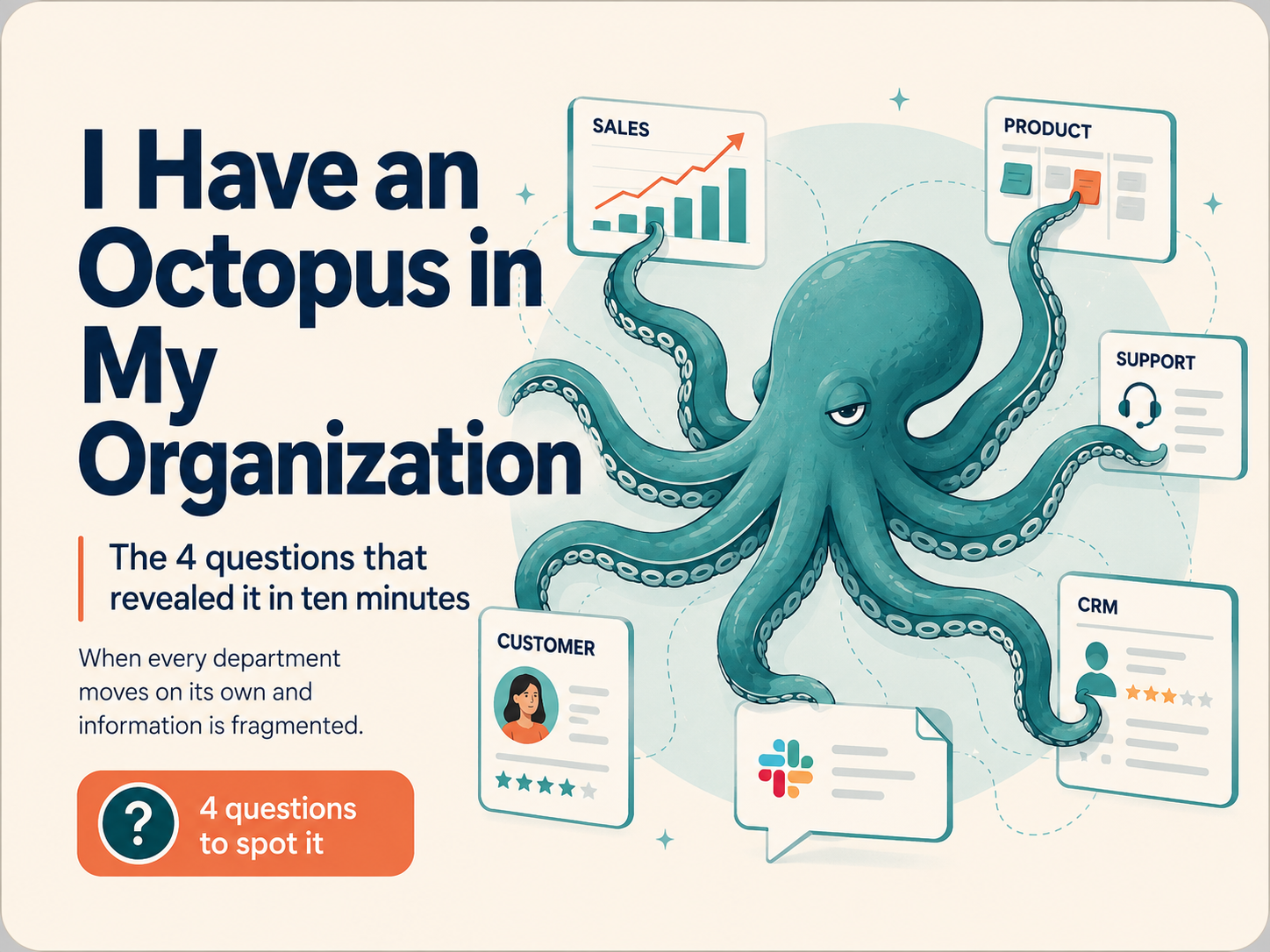
“It looks like an octopus. Each department is a tentacle going its own way. And the information is fragmented.”
I didn’t ask for more context at first.
It wasn’t necessary.
Anyone who’s tried to coordinate something between teams in a rapidly growing company recognizes that exact feeling: everything moves, everyone works, and nothing is connected to anything else. Lots of effort, but no central nervous system to hold it together.
From that meeting four questions came out with no clear answer to any of them.
The four questions
- How do you talk to each other across departments? “Mostly via Slack. And meetings that don’t reach conclusions.”
- How do you support each other when someone has a decision that crosses areas? “Everyone pulls their own way. If I need something from Product, I open a Jira ticket. We’re a very autonomous company.”
- Where do customer data end up in the end? “In Slack, in my notes, half in HubSpot, in the heads of specific people.”
- How much effort does each decision you make as management cost you? “A lot. Convincing, chasing, repeating, aligning schedules. Sometimes, when I succeed it only lasts a few days because there are always fires to put out.”
Four questions.
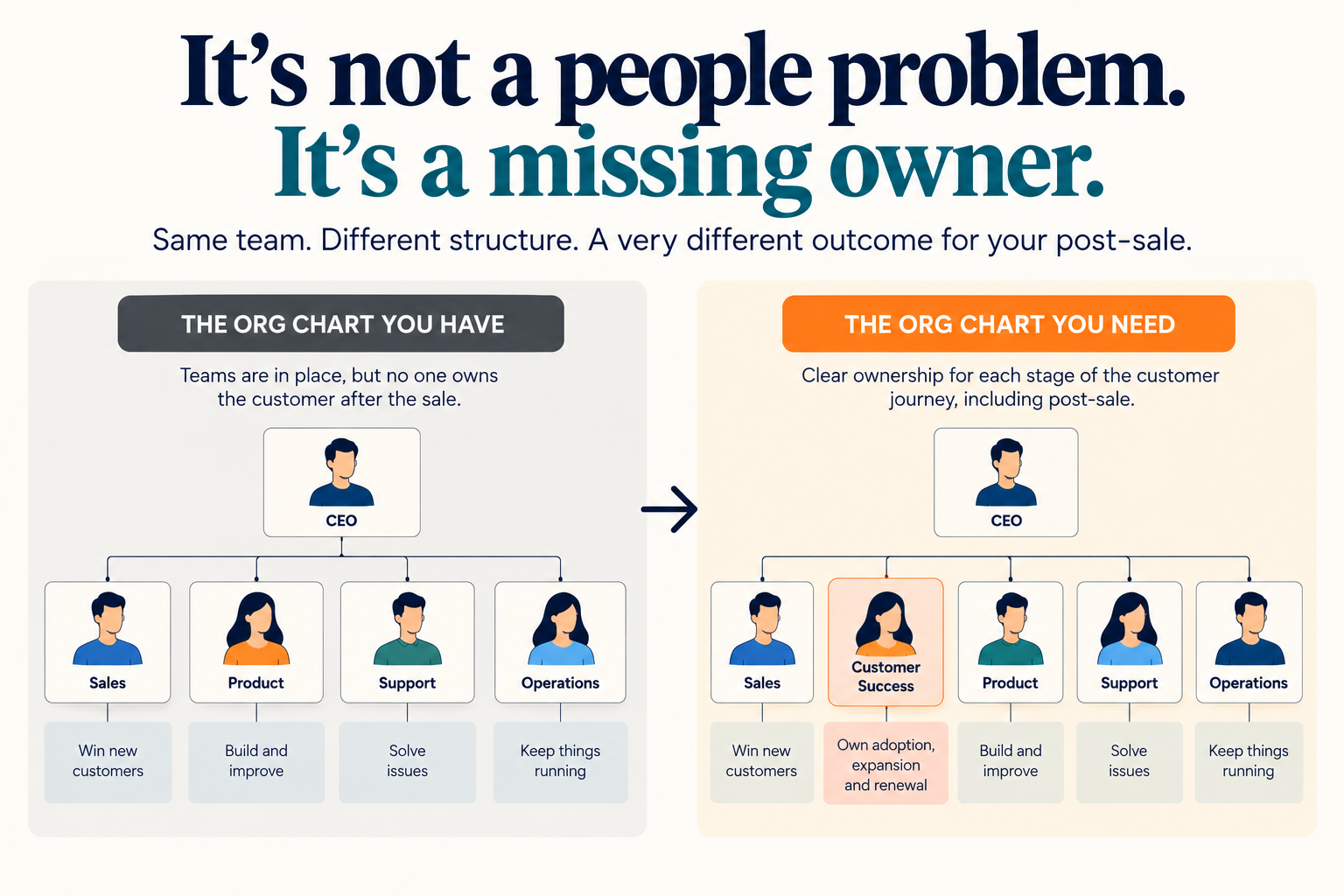
Four answers that describe exactly the same thing from different angles: no one designed how information moves within this company, nor how a decision is coordinated that doesn’t fit inside a single department.
The diagnosis she made herself and took as a task for her roadmap.
After the fourth answer, she was silent for a second. And then she said, on her own:
“I have a silo problem in my operations; on this break it’s very clear to me”.
And it isn’t a talent problem, because I know firsthand her potential, discipline and commitment. The problem is that individual or departmental effort, no matter how often it’s repeated, can’t replace a system that no one has built yet.
Why the octopus is the right metaphor
Because you grow as a company and hire to reinforce roles and tasks wherever needed, addressing that need and tasks without a communication system between the rest of the departments.
When each department is competent on its own:
- Product handles its stuff.
- Sales handles its stuff.
- CS handles its stuff.
But no one has designed how decisions that cross those areas are coordinated, nor where the information everyone needs lives, the result is exactly what this Head of CS described: lots of movement, lots of individual effort, and no progress that holds over time.
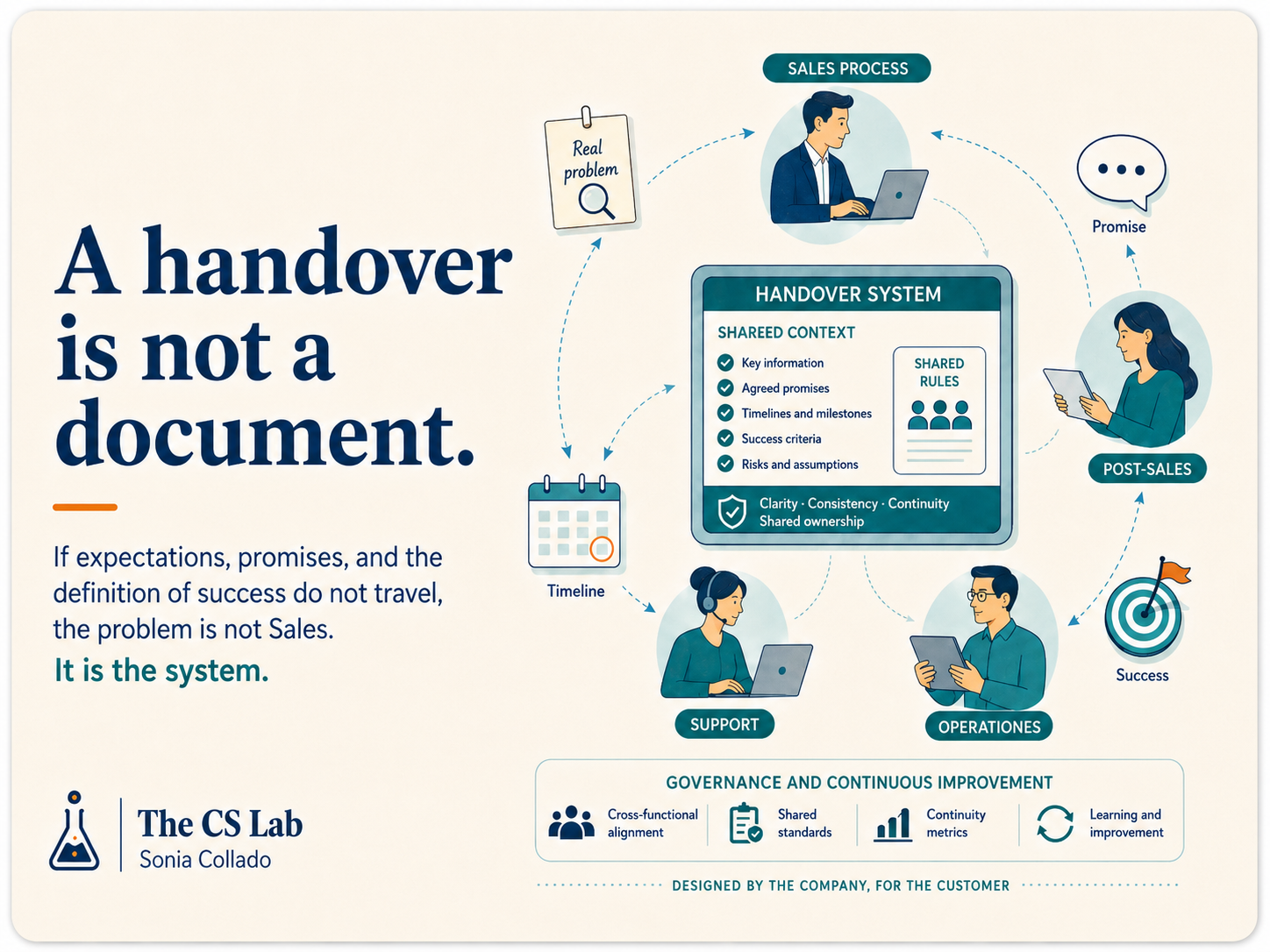
And the most expensive and hardest part is the invisible: the customer data that lives only in one person’s head and disappears if that person leaves, or a decision that’s made twice because no one knew it had already been made, and the account risk signal that one department sees and another never even learns exists.
This doesn’t get fixed with more meetings, nor with more tools, nor with more willpower; it gets fixed by designing where each decision lives,, who makes it and who’s responsible, and how the information reaches whoever needs it without depending on someone remembering to forward a message or ask for it.
Ask yourself the same four questions but with the new approach
At this point, if you answered similarly to the questions, I’ll give you a lighthouse.
- How do you talk to each other across departments? If the answer is “it depends on who’s awake on Slack that day”, you don’t have a channel. You have noise that looks like communication.
- How do you support each other when a decision crosses areas? If the answer starts with “I try…” or “I usually chase…”, that decision depends on the energy of a specific person, not on a process that survives if that person is on vacation.
- Where does the customer information end up in the end? If your answer includes more than two different places, you won’t be able to have the full picture to make strategic decisions.
- How much effort does it cost you to keep a decision alive? If you have to repeat it, remember it and defend it every two weeks, it isn’t a decided decision. It’s a permanent negotiation that never finishes closing and prevents you from moving forward and scaling.
Before closing this
If you saw yourself reflected in any of the four questions, you’re not alone. It’s more common than it seems, and it isn’t your fault because that kind of growth is common.
Now, are you ready to adjust it and design it to scale your company?
What other indicators have you seen that are critical signs your company needs processes before starting to scale?
Artículos relacionados