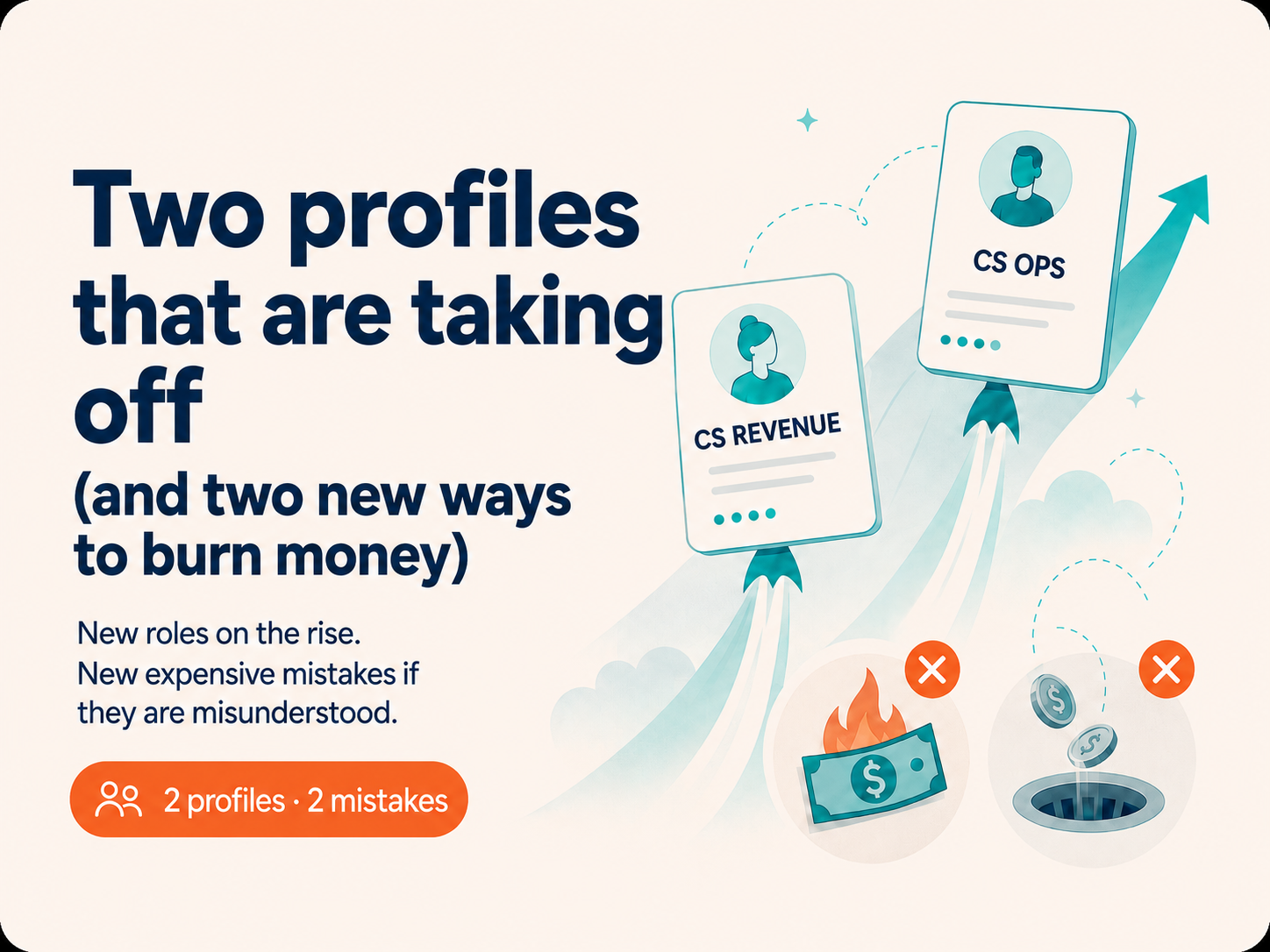
Two profiles that are taking off (and two new ways to burn money)
There’s a conversation repeating in the CS market right now, and it’s repeating from two sides at once.
From the founder’s side it sounds like:
“We need someone to bring order to post‑sales. We’re thinking about a CS Ops. Or maybe a more commercial profile to push renewals. Which do we hire first?”
From the CSM with years of experience it sounds like:
“I’ve felt for a while that I’ve hit a ceiling. Should I move into Ops or into revenue?”
Two different questions that share the same underlying mistake: both assume the problem is the profile. And the problem is almost never the profile, but the order.
The current phenomenon
I see more and more CS Ops and CS roles with ownership of revenue, and it makes complete sense since the market has understood that Customer Success can’t be just “managing accounts and putting out fires”, and these two profiles represent the professionalization of the function. One builds the machine. The other captures the value the machine generates.
The problem I see is that they’re being hired as if they were the solution, when in reality they’re amplifiers of something critical: if there’s a system underneath, they scale it, but if there’s chaos underneath, they scale that too.
How money gets burned (founder side)
The pattern I see repeating in B2B SaaS startups that grow quickly in sales:
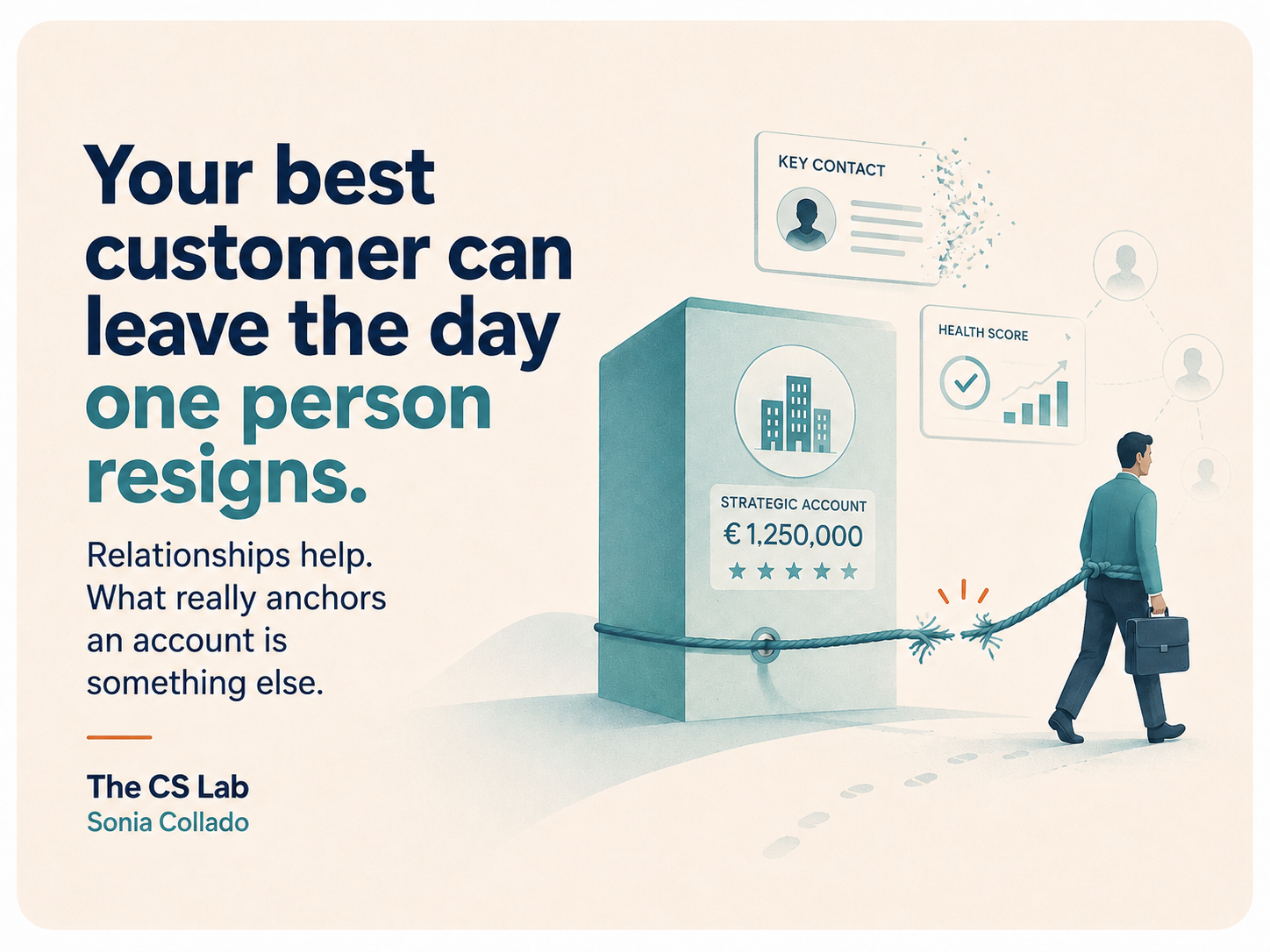
They hire a CS Ops or someone to fill that role to “bring order”. The profile arrives eager, sets up dashboards, defines processes, configures the CRM. And after three months they’re producing reports on data nobody trusts, for meetings where nobody makes decisions with them. Not because the person is bad, but because they were asked to operate a system that doesn’t exist. You can’t optimize what was never designed from the top.
⚠️ A real example: A company wanted an X‑ray of its customers to make better decisions. But departments didn’t want to share information, and the teams that had to build the dashboard each came with their own priorities. The result: in the first weeks a manual database was set up to see what information would actually help decide. Six months later, they were still the same, updating that data by hand. No one wanted to take responsibility for automating it, the data was poor, and no one at C‑Level was pushing the project.
Or they hire a CS Revenue profile to “push renewals and expansion”. The profile arrives with a commercial edge, and finds that no one knows how to distinguish a healthy customer from one at risk. The Health Score exists, but it’s a visual layer over an operation that doesn’t know who acts, when they act, or by what criteria. So the commercial profile does the only thing they can do: sell blindly, chase renewals without knowing which are really at risk, and propose expansion to customers who are two quarters away from leaving because they were told they “were happy”.
Meanwhile, the founder remains the informal CSM for the large accounts, the one who manages the relationship and part of the operations, the one who spends time operating while leaving strategy aside—and who was exactly what the hire was supposed to resolve.
How careers stall (CSM side)
The trap has a second side, and almost no one talks about it.
For someone who’s been a CSM for years, these two routes are the real exit from the ceiling of “more accounts or manager of CSMs”.
- CS Ops, for those who discovered that what they like isn’t the account but the system: designing processes, connecting data, building the machine that makes the rest work.
- CS Revenue, for those who feel comfortable in the commercial conversation: renewals, expansion, ownership of NRR.
But years as a CSM don’t automatically prepare you for either. They give you the raw material (knowing the customer from the inside, knowing exactly where the operation breaks because you’ve suffered it) but each route requires developing a different muscle. One asks for systems thinking and the other for commercial instinct. But there’s a third variable that almost no one evaluates before accepting the offer: the company.
Because a brilliant CS Ops in a startup without reliable data ends up making decorative dashboards, and a talented CS Revenue in a company that doesn’t distinguish healthy customers from at‑risk customers ends up burning out chasing renewals that can’t be anticipated.
The right profile in the wrong company isn’t a promotion, but a stalled career with a different title.
⚠️ Another real case. The CEO of a startup kept asking the sales and account management team: “Why don’t you sell more? Why don’t you delegate the paperwork? Why don’t you anticipate what the customer needs?”. What the team didn’t say out loud: there was no information and no system. To know how a customer was doing you had to chase multiple meetings and track their latest movements and incidents. And they were tired of going after revenue with a customer who had been down and without a response for weeks.
When it makes sense
This is where the two sides meet, because the answer is the same question asked from two seats: does the system exist?
- CS Ops makes sense when there’s already something to operate: a defined journey even if imperfect, a handover between Sales and CS that works most of the time, data the team actually uses to decide. Their job then is to scale and refine. Hired at that moment, a CS Ops multiplies. Hired before, they document the chaos.
- CS Revenue makes sense when the company already knows how to distinguish a healthy customer from one at risk. And not with a pretty traffic light, but with operational criteria: who watches the signals, what each signal activates, who acts. Their job then is to capture value where it already exists. Hired at that time, a CS Revenue turns retention into growth. Hired earlier, they monetize blindly.
And the sequence, before hiring these profiles, starts by designing the architecture: what information enters, what decisions are made, what actions are triggered, who owns what… Because without this design, the hire is throwing money down a well.
The question that orders everything
In your company:Depending on the profile you have, do the following:
- If you’re hiring: before opening the job, write on a page what system you’re going to hand that profile on day one. If the page stays blank, you already know what comes first.
- If you’re that profile and choosing your next step: in the interview, ask about the system, not the title. Ask to see the handover and ask who acts when a customer becomes at risk. The answers will tell you if you’re going to build on foundations or inherit the chaos with a new title.
In both cases, the right decision isn’t “which profile”, it’s “which order”.
In your situation:👉🏻 If you’re on the CS team, what advice would you give to solve your day‑to‑day problems?
👉🏻 If you’re on the hiring team, do you have the system set up to retain talent so your next hire isn’t a cost?
And if you’re on the founder side of this conversation and the page stayed blank for you, it’s exactly the type of architecture I design with B2B SaaS companies that grow in sales and lose revenue after signing.
Artículos relacionados