You Ask Your CSM to Demonstrate Value. Has Anyone Told Them What It Is?
On what we take for granted when we ask for “knowledge of the customer’s business”
A few weeks ago, I was talking with a friend about the incredibly ambiguous descriptions used in Customer Success job descriptions. However, when you want to get down to specifics and ask how they handle a process, the answers become generic and almost always end the same way: “it depends on the business, the product, the customer…”.
Among the list of requirements a CSM is expected to fulfill, there’s one phrase that appears in every job posting: “help the customer achieve value with the product”.
This sounds good and no one questions it, until you ask a CS colleague: How do you deliver value at your company? And suddenly, in the answer there’s an uncomfortable silence, followed by an individual version, built from intuition and experience based on what they’ve observed in their accounts.
And that’s where there’s a huge gap that almost no one talks about: we ask someone to make a value visible that the company has never sat down to define.
And although I see it especially in CS and post-sales, the problem goes much further, because it affects anyone who has to sit in front of a customer and explain why it’s worth paying for what you sell.
Real example: It happened to me shortly after joining a software company. I asked what seemed to me like the most basic question in the world: what value do we deliver to the customer?
The answer was the product’s main functionality, described exactly as it was. Basically, what the tool did.
I insisted, because something didn’t add up. Three or four other solutions on the market did the same thing, some of them cheaper. So why do customers buy from us?
“Because ours is more reliable.”
I insisted once more, looking for something concrete. And that’s when I heard the phrase I still remember: “there’s nothing more to it, the product does that and that’s it”.
That company had customers, generated revenue, and renewed contracts. What it didn’t have was an answer to why customers bought from it. And if the company doesn’t have one, the CSM won’t have one either.
Because only by knowing your value will you be able to help your customers achieve success.
First question: what value do we deliver?
Just as I did, try it at your company and ask five people what value your product delivers, then write down their answers.
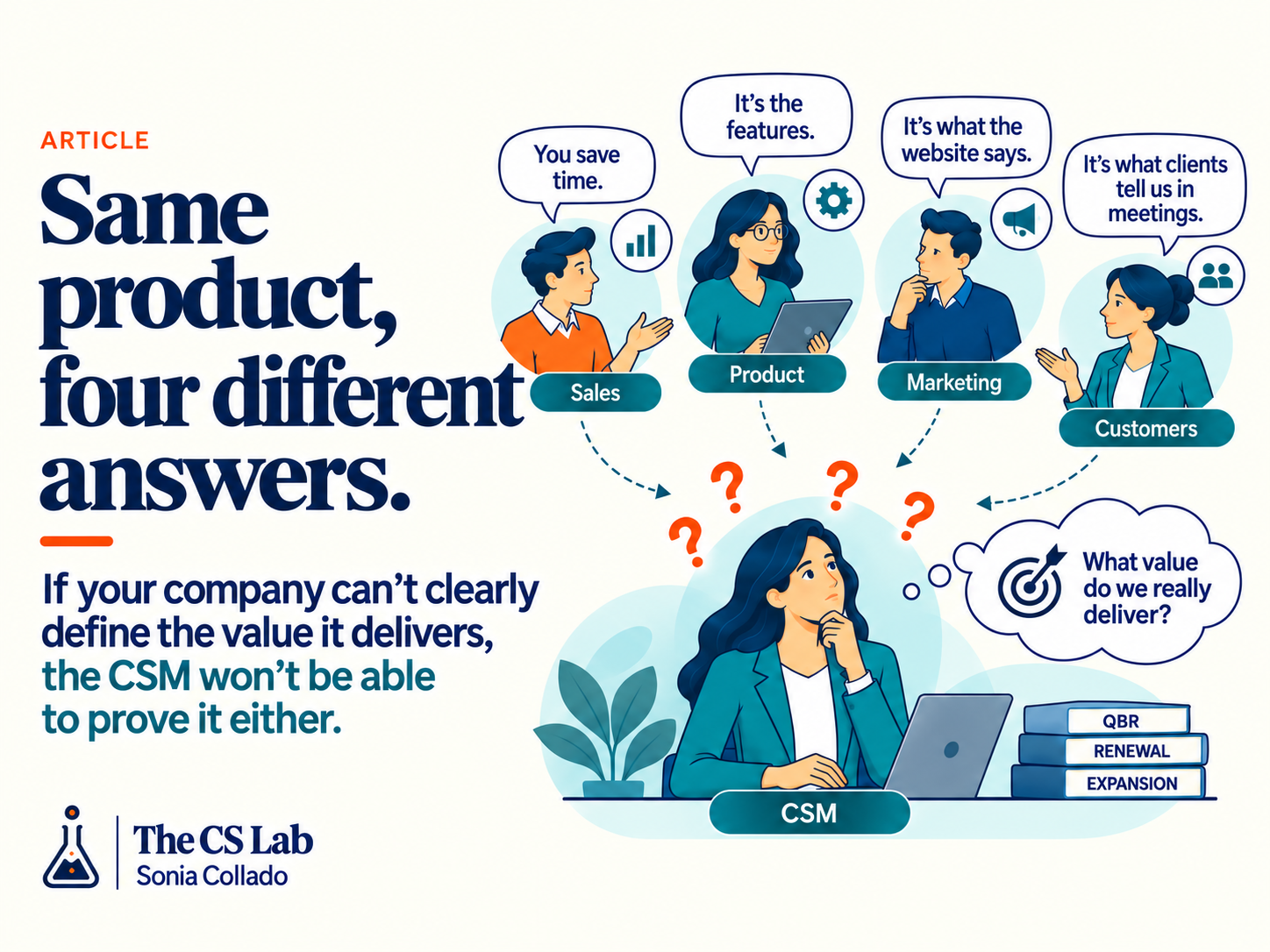
Most likely, you’ll find that Sales talks to you about saving time, Product about features, Marketing about what’s on the website, and CS about what customers tell them in meetings.
Each department, a different answer.
The thing is, value isn’t a nice phrase; it’s a concrete statement that every department should be able to support and repeat consistently: what problem we solve, for what type of company, in how much time, and with what measurable result.
If that isn’t written down somewhere, it doesn’t exist; and if it doesn’t exist, what we saw above happens: each department gives a different answer, and the “person responsible for delivering value”, the CSM, improvises their own narrative, with a slightly different promise in every QBR, and the company ends up constantly shifting its understanding of what it means to be “a good customer” and for “a customer to be doing well”.
Let me be clear: if your company doesn’t know how to articulate its value, your CSM won’t be able to demonstrate it, no matter how good your team or product is.
Second question: who teaches them about the customer’s business?
Here comes the part that receives the least attention and is taken for granted..
CS teams are told that demonstrating value isn’t about showing the product, but about connecting what your product does with what keeps the customer awake at night. But to achieve that, it’s necessary to understand their business: how they make money, what puts pressure on them, what metric their manager looks at, and what makes them look good in a committee meeting.
And this is where we ask for something we’ve never provided. We expect the CSM to have industry knowledge, yet rarely has anyone taught it to them. It’s assumed they’ll pick it up along the way, by talking to customers, reading on their own at weekends, and asking someone in Sales who’s been there longer.
And they do pick it up, of course. Over time, your good CSMs learn it, but they do so late, unevenly, and at a cost that no one accounts for, because every new hire has a learning curve, which is normal, but your customer is paying for that curve in every conversation.
And then, during the performance review, they’re told that “they lack business acumen”, without ever having been given either the training or the tools to develop it.
And the third one, which is the trap
What if they manage twenty accounts across eight different industries?
Because this is what really happens in most horizontal B2B SaaS companies. A portfolio with a logistics company, two retailers, a consultancy, a manufacturer, a public-sector organization, and three startups from industries that have nothing in common.
Asking that person for “deep knowledge of the customer’s business” isn’t a demanding expectation, but rather an impossible expectation, and on top of that, we’ve turned it into an evaluation criterion.
And this is the pattern I repeat often: when you ask someone to compensate through individual effort for something that should be solved through design, you don’t have a talent problem; you have an architecture problem.
So what could be done?
The first thing I’ll tell you is what doesn’t work: this won’t be fixed by sending your team to a course or asking them to do more research on their own.
Here are four decisions that do move things forward, and none of them are in the CSM’s hands.
1. Write down the value, once and for all, on one page. What problem we solve, for whom, in how much time, and how it’s measured. Value can’t be “the website pitch”; it has to be what you truly uphold as part of your DNA. Sales, Product, and CS must sign off on this value together, because if each has its own version, the customer receives three.
2. Decide whether to segment the portfolio by industry. And be careful, because this is a company decision, not a preference of whoever leads the team. If you have enough volume in two or three industries, grouping portfolios by vertical changes a lot: the third logistics account that person manages is half as difficult as the first, because knowledge accumulates instead of spreading in eight different directions.
And if you can’t segment, that’s fine, but then be aware of what you’re asking: you’re asking your team to be generalists, and that needs to be reflected in how you evaluate them. You can’t demand industry depth from someone who manages eight industries at once.
3. Build the knowledge once and share it. Right now, at your company, there’s someone who already understands quite well how the logistics industry works because they manage three accounts. That information is in their head, but it should be somewhere that whoever joins tomorrow can find it: how that industry makes money, what puts pressure on it, what objections always come up, which use cases work, and which arguments have landed in a committee meeting.
4. Give them real ammunition, not generic training. Customer cases from the same industry with concrete results, questions that work in discovery, the metric a CFO looks at compared with the one an operations director looks at. Marketing or Product can prepare this, and it has a much greater impact than a skills workshop.
As you can see from these examples, none of these things can be done by a CSM alone, since they’re decisions with cross-functional authority—decisions whose lack of structure is paid for by the customer.
What you can do depending on where you are
If you’re a CSM, you can start by writing down, in one sentence, the value you believe you deliver and comparing it with someone in Sales and someone in Product. Not as an exam, but as an alignment of expectations, because you need that sentence to sit in front of a customer.
And if the three versions don’t match, you haven’t found someone to blame; you’ve found something to solve together. Presenting it as something you need to do your job well opens many more doors than presenting it as someone else’s failure.
If you lead the team, do the exercise with your people in a meeting and note the differences. Then ask yourself the uncomfortable question: how much industry knowledge do we have written down, and how much exists only in people’s heads? If the answer is that almost all of it is in people’s heads, you’ll notice the day someone leaves in the accounts.
If you’re a COO, CEO, or lead Revenue, this is about something bigger than CS, because if your team can’t articulate value precisely, it isn’t just a retention problem: it’s also a problem of pricing, expansion, and differentiation from the competition. In the end, a customer who can’t explain what they gain from working with you is a customer who will compare based on price.
The thing is, we ask the CSM to be the translator between the product and the customer’s business. But a translator needs to know both languages, and we’ve only taught many of them one.
If you feel like bringing real order to this, aligning the teams, and putting in writing what value you deliver and how it’s demonstrated, write to me and we’ll do it together.
Tell me something: if you asked at your company today what value you deliver, how many different answers do you think you’d get? I’ve had people give me four in the same meeting.
Artículos relacionados