From Churn to Expansion. When defending decisions instead of features changes your relationship with your customer.
A few years ago, I had an account whose Health Score had been falling for weeks. My contact and client, who until recently used it regularly, suddenly went silent.
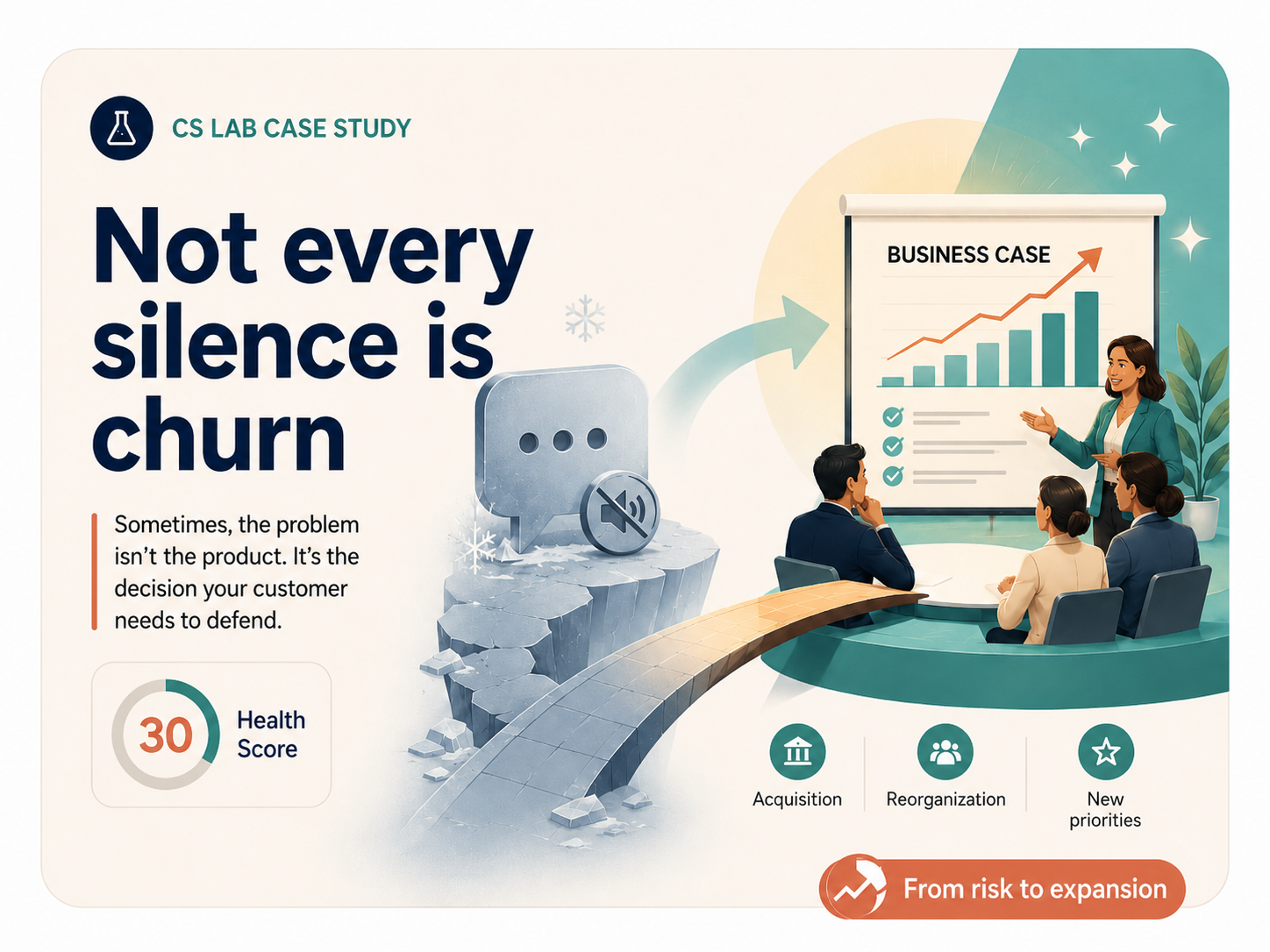
The score dropped to 30 points and, without knowing what I had done wrong, churn was looming.
➡️ I called him several times.
➡️ He didn’t answer.
➡️ I kept insisting and not about the renewal, which was already approaching, but because something didn’t add up.
➡️He didn’t respond….
When he finally called me back, I decided not to talk about the product, or the company. I knew something was wrong, the situation felt odd and I asked him how he was, what was happening at his company, and if there was anything I could help with beyond the tool.
And then everything came out: they were in the middle of an acquisition by another company. He had had his mind completely on that for months.
The renewal was approaching and he hadn’t reopened the product — not because he’d stopped believing in it, but because his reality had completely changed and no one had made it easy to fit it into that reality.
On that call I said to him:
“See you in a week. From what you’ve told me, I’ll prepare something to help you in this new situation.”
The uncomfortable truth
The problem wasn’t that the product had stopped delivering value, but that ethe value it delivered was no longer connected to the decision he had to make now, to his new priority.
Before, the tool helped him manage his technology team, but now what he really needed was to defend before a committee, in the midst of an acquisition, why his investment in that software made sense. They were two completely different decisions, and no one had redesigned the tool, nor the conversation, to serve the latter.
This happens constantly with accounts that “go cold”: it’s not that the customer stops needing what they bought. It’s that their context changed: a reorganization, a merger, a change of boss, and no one asks what decision that person needs to make now, nor how to help them defend it.
The 4 questions I asked myself before preparing anything for him
This is the first thing I ask myself today when any account goes silent, before assuming it’s a product problem:
- What decision does this person need to defend right now, and before whom? Not “what do they need from the product” but what they have to justify, to whom, and within what timeframe. In this case: defending it before the committee was the question that really kept him up at night, not using the tool.
- Who is the real owner of that decision, and how often do they have to justify it? It was him, a single time, before a committee with a lot of decision-making power over his future. It wasn’t a recurring or operational decision; it was one-off and high-risk. That completely changes the type of help required.
- What do I have to change so that they can defend it without extra effort? I didn’t send him the manual. I didn’t explain the product again. I removed the learning barrier completely: I prepared the material from his perspective, as if he were the one who had to present and justify it, not me defending the product in front of him.
- How am I going to know that this worked, and not just that “the meeting went well”? The real signal wasn’t him smiling as he left the committee. It was what happened with the account afterwards: whether it renewed, and whether the conversation opened up to move forward again instead of closing.
How it turned around
A week later, I came back with a presentation that wasn’t meant for him to understand the product better. It was meant so he could defend his own situation before the committee, with the product as evidence in his favor. I didn’t position myself explaining the value; I positioned it as he would explain it, anticipating how he’d justify each piece of data, which achievement he’d highlight first, what objection they’d raise and how he’d respond.
After that meeting, we adjusted some parameters, added additional information and I returned the data to him so he himself could give it the final touches, because the message had to feel like his, not mine.
Added also supporting notes with the questions they’d probably ask him at the committee. We told him that, if he wanted, we could accompany him to the meeting. It wasn’t necessary.
A month after that call, he wrote to me: the committee had gone better than expected. And, after some additional tweaks, he wanted us to accompany him to delve into certain data in depth and support a commercial proposal for expansion in his portfolio.
An account with a Health Score of 30 and assumed churn ended up in an expansion conversation.Why this pattern repeats in B2B SaaS accounts
It’s almost never that a customer goes cold because the product stopped working. They go cold because their context changes — an acquisition, a reorganization, a change of priorities higher up and no one redesigns how that tool serves the decision that person has to defend now, not the one they had when they bought it.
CS teams keep pushing the same old argument: “look at everything you can do with this” when what the account needs is a much simpler question: what do you have to justify, to whom, this week? And, how do I make it easy for you?
Before wrapping this up
Think about the account that worries you most right now, the one that’s been silent for weeks or with usage falling.
Do you know what decision that person needs to defend today, and before whom?If the answer isn’t immediate, you don’t have a product problem, because they’ve already decided to buy you — it’s how you’re supporting them that’s the issue.
When I go into a company, this is exactly what I do: map where the revenue leaks after the sale, account by account. Not where you think it leaks. Where it actually leaks.
Artículos relacionados