In a year, your customer won’t renew against the contract, but against their expectation of what they signed.
For years I thought a good handover was a good document, something that would be clear for transferring information like: contract, scope, contacts, terms, dates… Everything organized, everything complete, everything handed over so the CSM had it all in one document.
The reality? Some projects still got off on the wrong foot.
Until, with time, I understood that that “document” moved data from one place to another but didn’t transfer the information that really mattered, the information that didn’t appear in any CRM — and I’ll tell you about it below.
What really arrives broken
When a customer signs with your company, they don’t buy a scope; they buy an idea of what will happen next.
They’ve pictured something, a situation in which they or their team stop doing something “tedious” or manual that will save them “something” and finally they’ll be able to present it to a committee. And they know this because the person who “sold” them your product understood their problem, showed them the solution, and so they know this is going to work.
Now ask yourself, is this in the contract?
No, probably not. What you do have is your document: what was sold, for how much, and with which modules. What doesn’t arrive is the why: what they expected to achieve, in what timeframe, and what, in their head, it means for this to have gone well.
And this is where most churn originates, the churn we later try to explain with health scores, with follow-up meetings and, sometimes, concessions.
Because in a year, that customer won’t renew against the contract; they’ll renew against what they imagined.What changed when we actually knew it
Two situations I lived through changed how I understand a good handover.
The first.
When we managed to get to CS what the customer truly expected, we stopped starting “the usual way,” with the first step that didn’t add much value, which was a custom configuration carried out weeks before the customer saw anything.
Instead, we decided to start by analyzing what unblocked the operations. In a week I already had an insight, a first concrete result I could use and show. Additionally something I didn’t expect happened: the collection of invoices sped up. Two quick wins for the price of one.
And it makes total sense when you think about it. A customer who still hasn’t seen anything has every incentive to go slow with payment, but a customer who has already obtained something useful doesn’t — they want everything and they want it now because they’ve seen the potential. Time to value isn’t just an adoption metric. It’s also a cash metric.
The second.
This was the one that made it clear to me that the handover is a risk-detection mechanism, not an administrative formality.
By understanding what the customer expected to achieve with the product, CS could raise their hand and say something uncomfortable: that commitment, with the team we had at the time, couldn’t be assumed.
Not stopped because someone had a bad premonition. It stopped because, for the first time, the person who had to execute it knew what had been promised before it was too late.
And here’s the important part, which almost nobody sees: the problem wouldn’t have stayed in that account, since committing the team to something unfeasible would have paralyzed the projects of other customers, with their own commitments and penalties. That decision didn’t save one account. It avoided a domino effect of unfulfilled obligations.
So keep this in mind when you have to create your Handover:
A properly done handover doesn’t just help you start better, it lets you stop in time.
Why handover templates don’t solve it
I’ll say it plainly: because most templates I’ve seen collect the same things and none capture what was said in meetings and is almost never written down:
- What problem they came to solve. Not the generic use case. The concrete pain that made them sign. “They’re losing two days a month closing reporting” is useful. “They need to improve efficiency” is nothing.
- What was promised exactly. Including what was said verbally in a meeting and isn’t in the contract. This is what hurts most and what’s least transferred, because putting it in writing feels like a confession, but it shouldn’t be: almost always that promise was made to unlock a deal that needed to close. The problem isn’t that it was promised, it’s that no one else found out and no one knows how to solve it.
- What deadline they expect. The customer almost always has a date in mind, even if it’s nowhere. A committee, a quarter close, an audit. That date determines whether your onboarding plan is reasonable or going to be late from day one.
- What it means for them that this works. And who within their company needs to be convinced. Because many times the person who signs isn’t the one who decides renewal.
And it doesn’t start when the contract is signed
Here’s the part that usually makes people uncomfortable, and it’s the part that really changes things.
If that information wasn’t collected during the sales process, it can’t be transferred later. And it’s not anybody’s bad will: it’s that no one defined that it had to be collected. A salesperson is measured by closing, and if it’s never agreed that those four things are part of the close, they won’t be there.
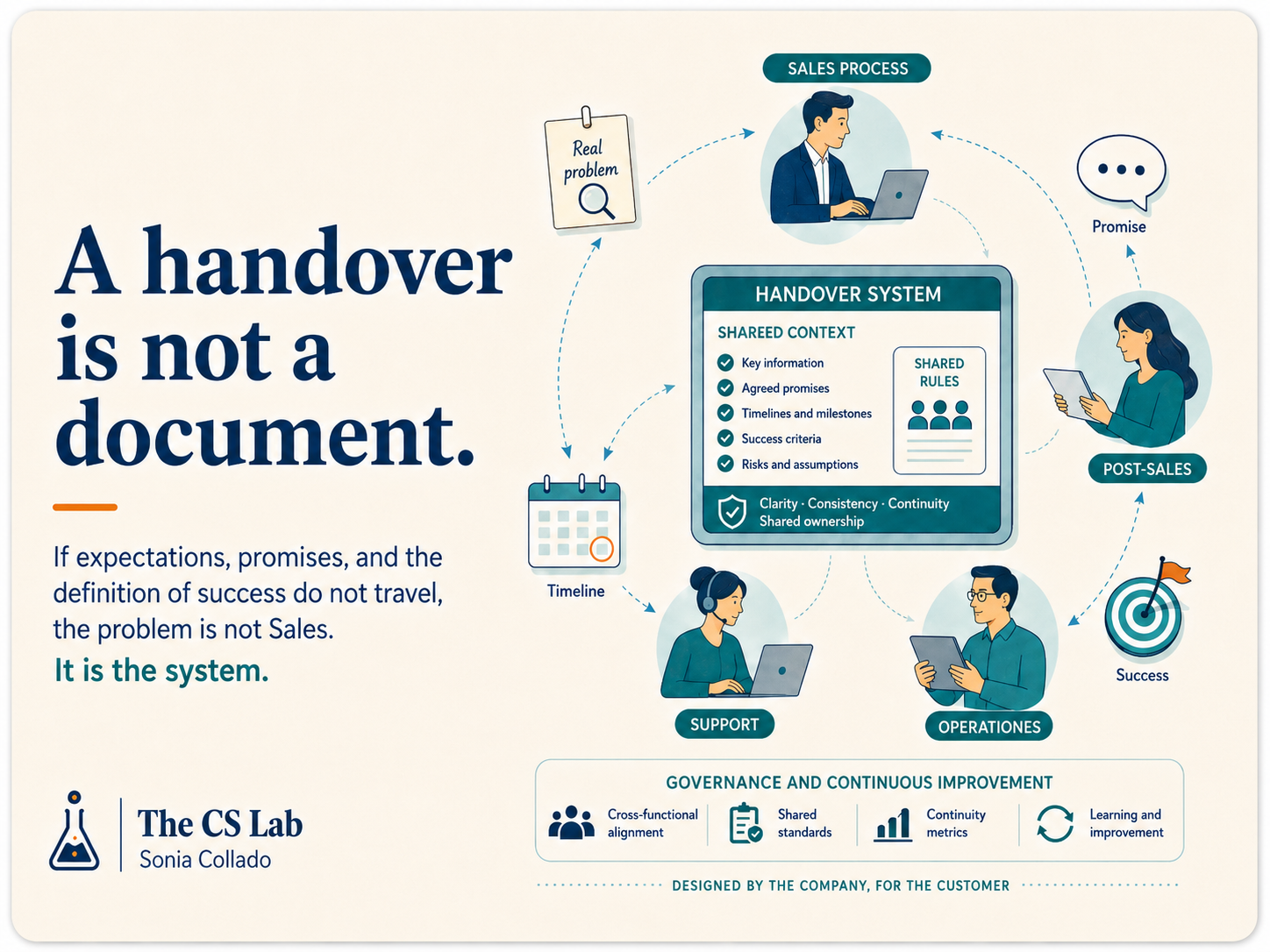
That’s why the handover isn’t fixed by scheduling a better transfer meeting or creating more fields in the document. It’s fixed by deciding, beforehand, what information must be captured during the sale because post-sales (KAM, CS, Ops, Support, …) will need it.
And that’s no longer just a CS issue, or a sales problem; it’s an agreement between several teams about what to ask, where it’s stored, and who’s responsible for it, because we all share the common goal of growing the company. Sit down, talk, and treat the issue with the customer in the middle.
How to set it up without a six-month project
Four moves, and none require a new tool.
- Write the minimal list. The four things above, adapted to your product. Fit them on half a page. A long list doesn’t get filled out, and one that isn’t filled out doesn’t exist.
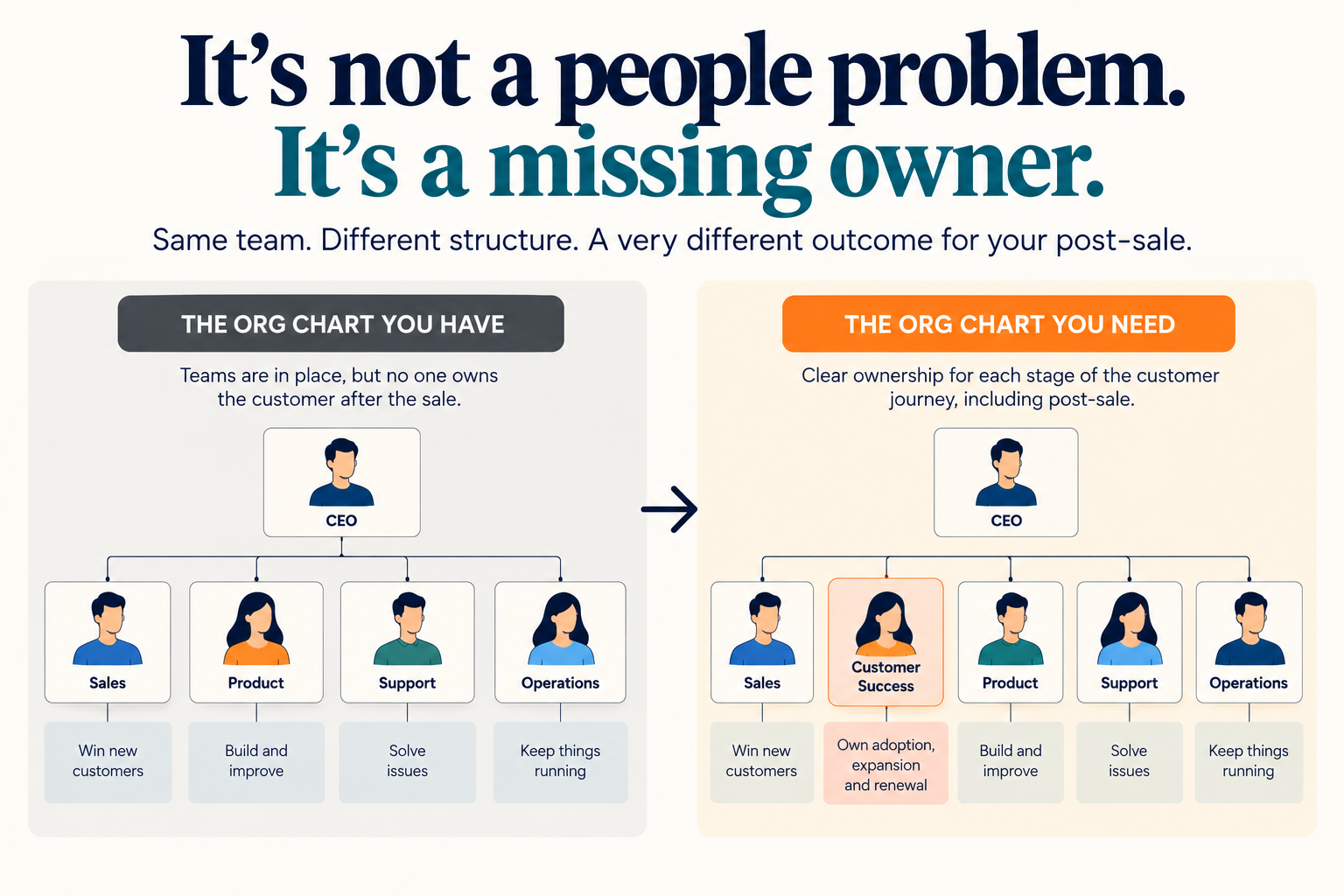
- Give the handover an owner, not just the data. Someone has to be responsible for the handoff happening, not just for the information existing. If no one is, the handover becomes an email answered when someone can.
- Have the customer validate it. This is the step almost nobody takes and the one that pays back the most. In the first session, read aloud what you’ve understood they expect to achieve and in what timeframe. Two things will happen: either they correct you and you just saved three months of work in the wrong direction, or they confirm it, and now you have a shared agreement on what success is.
- Give Operations the right to stop things. It’s useless to detect an unfeasible commitment if the one who detects it has no way to stop it. That right must be given explicitly and be spoken aloud: using it is doing the job well, not being negative. If your team believes raising their hand will cost them, they won’t raise it, and the problem will appear anyway, just later and more expensively.
What you can do with this
- If you’re KAM or run Sales, this isn’t against you. In fact, you’re the one who has the most to gain. And there’s one part only you can contribute: recording what was said verbally. That promise you made to unlock the deal, that timeframe you gave without confirming it with anyone, that feature you said was just around the corner.
It’s not an exam or a control. It’s that if it doesn’t travel, the person who will be in front of the customer when they ask for it won’t be you. And there’s an advantage that often goes unnoticed: a customer who gets what was promised renews, expands, and introduces you to others. The quality of your handover is the quality of your references in a year’s time.
That said, this shouldn’t depend on your memory or goodwill. If your company hasn’t defined what’s collected, where it lives, and who’s accountable for it, the fault isn’t yours. You can contribute the context because you’re the only one who was in that room. But getting it to the other side is a matter of the system.
-
If you’re the CSM, start by documenting what’s missing. Every time you have to reconstruct by hand what was promised, write it down. After a month you’ll have a pattern, and a pattern is a different conversation than a lone complaint.
-
If you’re on Support, you’re probably the team that receives the least of the handover and the one that sees the consequences first. You get tickets without knowing what that customer expected to achieve or what was promised, so you solve isolated incidents without being able to assess which ones are signs of something bigger. Two things change a lot here.
-
Ask for the minimal context for the accounts that matter most: what they bought, why, and what’s critical for them. Not to treat them differently, but to know when a normal ticket is actually touching the only thing that customer cared about.
-
Your information has to travel back. A customer who opens the same type of incident three times about the process they came to solve isn’t a support problem. It’s an early renewal warning by months, and many times no one else is seeing it. Notice this isn’t a chain, it’s a circle: what Support sees has to go back to Sales as guidance on what to promise and what not to promise.
-
If you lead the team, take the last three accounts that started poorly and look for what information didn’t travel. Not to point fingers, but to build the minimal list with real cases on the table. It’s much easier to agree on a change with three examples than with a theory.
-
If you’re COO or CEO, this isn’t paperwork between departments. It’s the point where your company decides whether it will deliver what it sold. And the question I’d ask at the next committee is simple: of the accounts that started badly last quarter, in how many did the problem appear after signing, and in how many was it already there and nobody saw it?
Because the cost of a broken handover isn’t paid in onboarding, it’s paid in the renewal that never comes, in the invoice that’s delayed, and sometimes in a commitment you should never have accepted.What have you most often had to reconstruct by hand because it didn’t arrive in the handover? Tell me, I’m curious to see if the pattern repeats.
Artículos relacionados