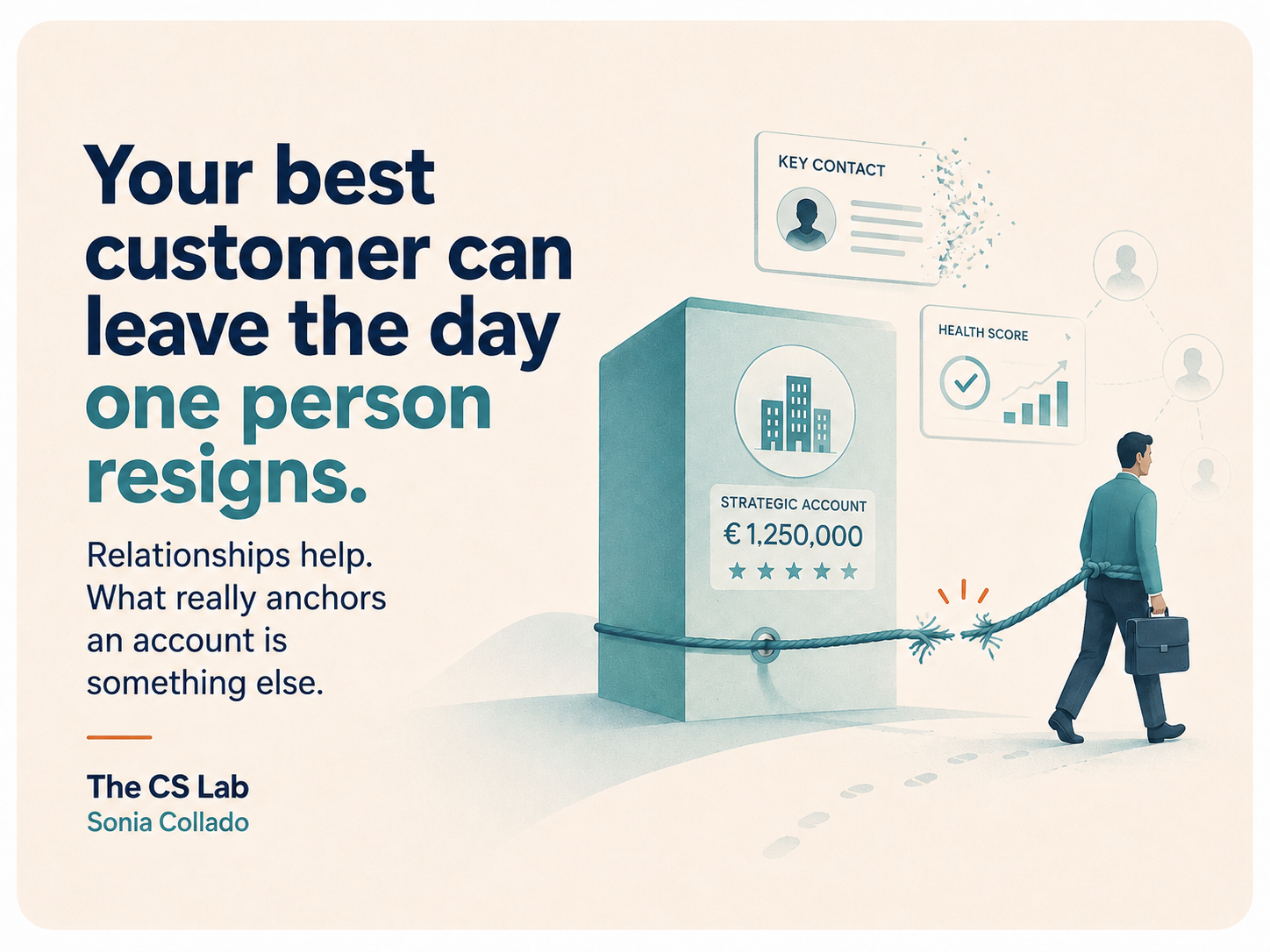
Your best customer can leave the day someone resigns.
I’ve managed portfolios of 1.5 million, and I’ve always found accounts that mattered more than anyone said out loud.
That’s why, I know what a CS team does when this happens because I’ve done it myself: more meetings, more presence, a three-day meeting prep, 20 minutes to answer an email that could wait a few hours,…. What I was doing was being available for things that weren’t my responsibility because it was “for that account”.
The instinct was right because that account can’t fail, but with these actions we don’t prevent the customer from leaving, no matter how much we care for them; what we do is make them more important, nothing more.
The question a buyer asks
I read an article this week by Joshua Novick about customer concentration in company sale processes.
Imagine you want to sell your SaaS and an investor or a competitor interested comes along, looks at your numbers and sees that a single customer represents 70 percent of your revenue. An alarm goes off, because if that customer leaves after the acquisition, a large part of the business that just paid disappears.
But how could they leave? This customer has been with you for years and the relationship is excellent.
The problem is that your buyer knows something you’re not taking into account: after an acquisition, people change.
- You might leave, the one who had the relationship with the client’s CEO.
- The CSM who’s managed the account from the start and who’s adored there might leave.
- Priorities may change
- The entire team may change.
And if that excellent relationship lived in those people, when they leave there’s nothing left holding the customer. The new buyer is left with a huge account, without the bond that held it together.
That’s why what they look at isn’t whether the customer is happy, but how costly it would be for them to leave, and that question, in most CS teams, has no answer. We know if the customer is satisfied, we have the health score in green and a great relationship with our contact, but if someone asks us how costly it would be for that account to replace us, we don’t know.
We measure how the customer feels. We don’t measure whether they can leaveYou don’t need to sell your company for this to happen to you
And here’s the important part: that scenario that scares the buyer — people disappearing and the relationship left untethered — doesn’t need an acquisition to occur. It happens every few months and it’s rarely measured:
- Your CSM leaves. The person who handled the account changes jobs, and with them goes the context, the trust and half the relationship. On the other hand, your new CSM inherits a customer who doesn’t know them.
- Your client contact leaves. Your interlocutor gets promoted, changes area or leaves the company and you discover that your entire relationship was with that person, not with the company, surprise!
- Someone new comes in at the top. A new director arrives with their own ideas, their trusted vendors and a desire to show they’re reviewing inherited contracts.
In any of the three cases the exact same thing happens as in an acquisition: the people where the relationship lived disappear, and only what was tied by design remains standing.
A due diligence shows it to you at once, but turnover shows it to you over time.What really ties an account
After the article and my experience, here are four things that really hold them and none of them is the relationship:
- Granularity inside the account. A large customer is almost never a single thing. They can have multiple contracts, multiple lines, departments or subsidiaries that decide independently, and that difference changes everything: if the whole relationship is one contract with one team, losing it is losing the entire customer at once. If there are four contracts with four areas, a bad renewal won’t take down the account.
- Real depth, not perceived. How many of the customer’s processes run through you? What would they have to rebuild if they left tomorrow? Do they have their data living in your product, integrations with their systems, people trained specifically to work this way? A customer who replaced their way of working with yours has a real exit cost. If the old process is still alive, your depth is smaller than you think.
- People. If the whole account rests on one contact, you don’t have a customer, you have a favor. And favors run out the day that person changes position, company or mood. It’s one of the easiest things to fix and one of the least done, because the single contact is convenient: they respond fast, they know you, there’s no friction, but a single interlocutor is not a relationship with a company, it’s a relationship with a person inside a company.
- Margin, not revenue. This is the one almost no one in CS looks at, and the one that changes the conversation the most. Large customers negotiate better terms, so it’s common for the margin with them to be lower than with the rest of the portfolio. That 70 percent of revenue can be 35 percent of the margin. Be careful prioritizing by invoice and not by margin.
Why more meetings won’t fix this
Go back to the start of this article.
Spending more time, giving absolute priority, always being available so that account will say everything’s fine,… none of that reduces the risk of them leaving, because the four examples of things that actually tie an account aren’t achieved by being more available. They’re achieved by design: in how many areas of the customer you enter, which of their processes your product absorbs, how many interlocutors you build, what criteria you use to prioritize the portfolio.
And yet, when a large account shows signs of stress, what we do is increase contact by giving more follow-up, more attention, more presence.
Not because it’s wrong, but because it’s the only thing the CSM can control. They can’t decide which areas of the customer the product enters, nor demand that more interlocutors be built, nor change how the portfolio is prioritized. So they do what they can with what they have, and part of what they have is meetings.
Meanwhile, the real risk stays exactly where it was, only now you also have a burnt-out team.
Who should step in, and when
Here’s the fundamental change: a concentrated account isn’t a CS account. It’s a company account. And while one person is the owner, no matter how good they are, you’ll have the same problem with a different face.
These are the alarms that should trigger more than a follow-up email, and who should move in each case:
- A single interlocutor supports more than X percent of your revenue. Set a threshold and, when it trips, bring in another interlocutor, for example, Sales or whoever handles expansion, not the CSM. Building a second and third interlocutor isn’t follow-up, it’s a commercial task of mapping inside the customer. This has to be done when everything is going well, not when there’s stress, because asking for new introductions in the middle of a crisis smells like what it is.
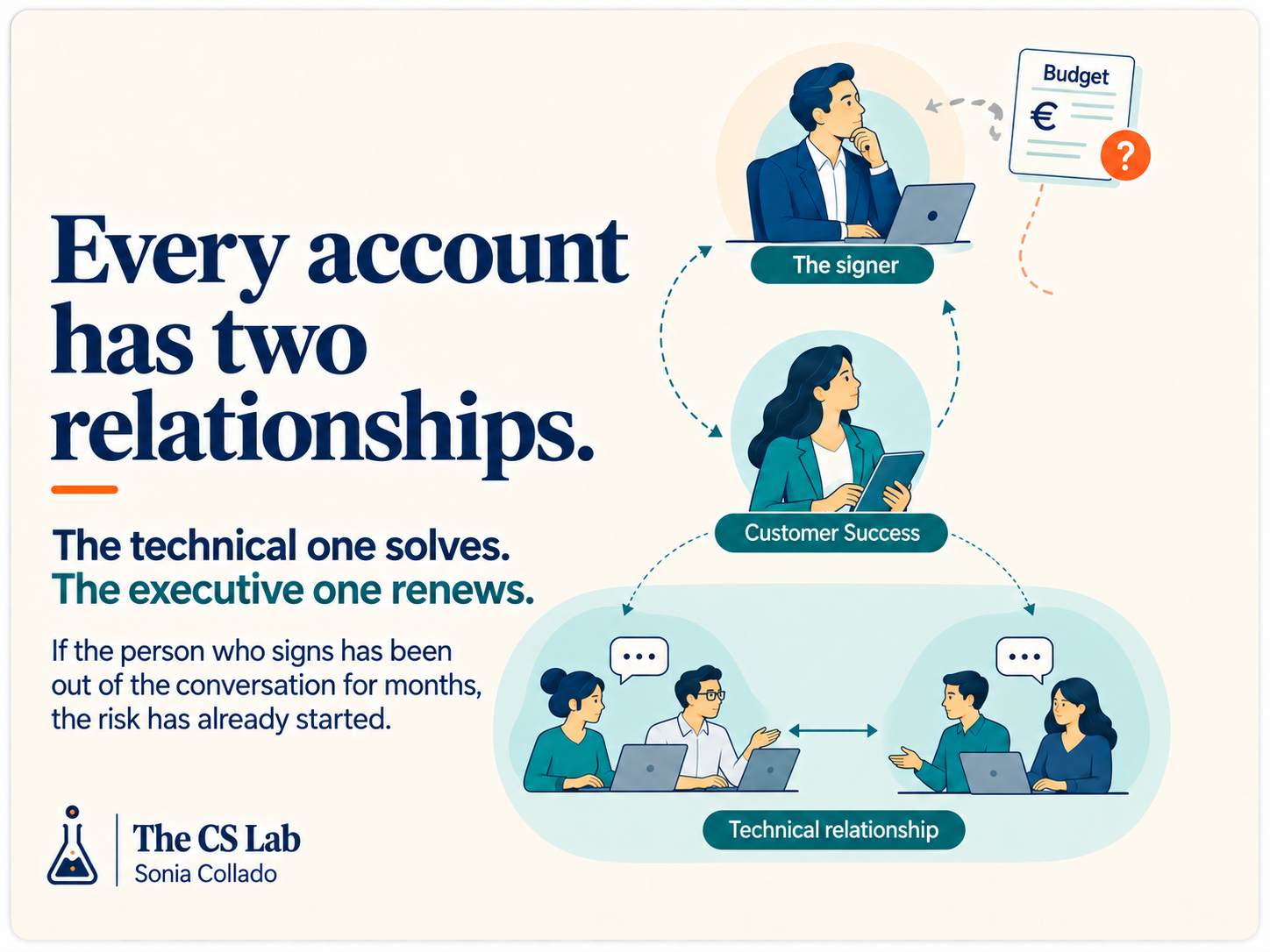
- Your main contact changes role, area or company. This is not a CRM update, it’s a risk event. It should trigger a relationship recovery plan with a date, not a “let’s see who the new one is”. And here who should appear is leadership: a change of interlocutor in your largest account is covered with a call from someone on your committee, not a handover meeting between CSMs.
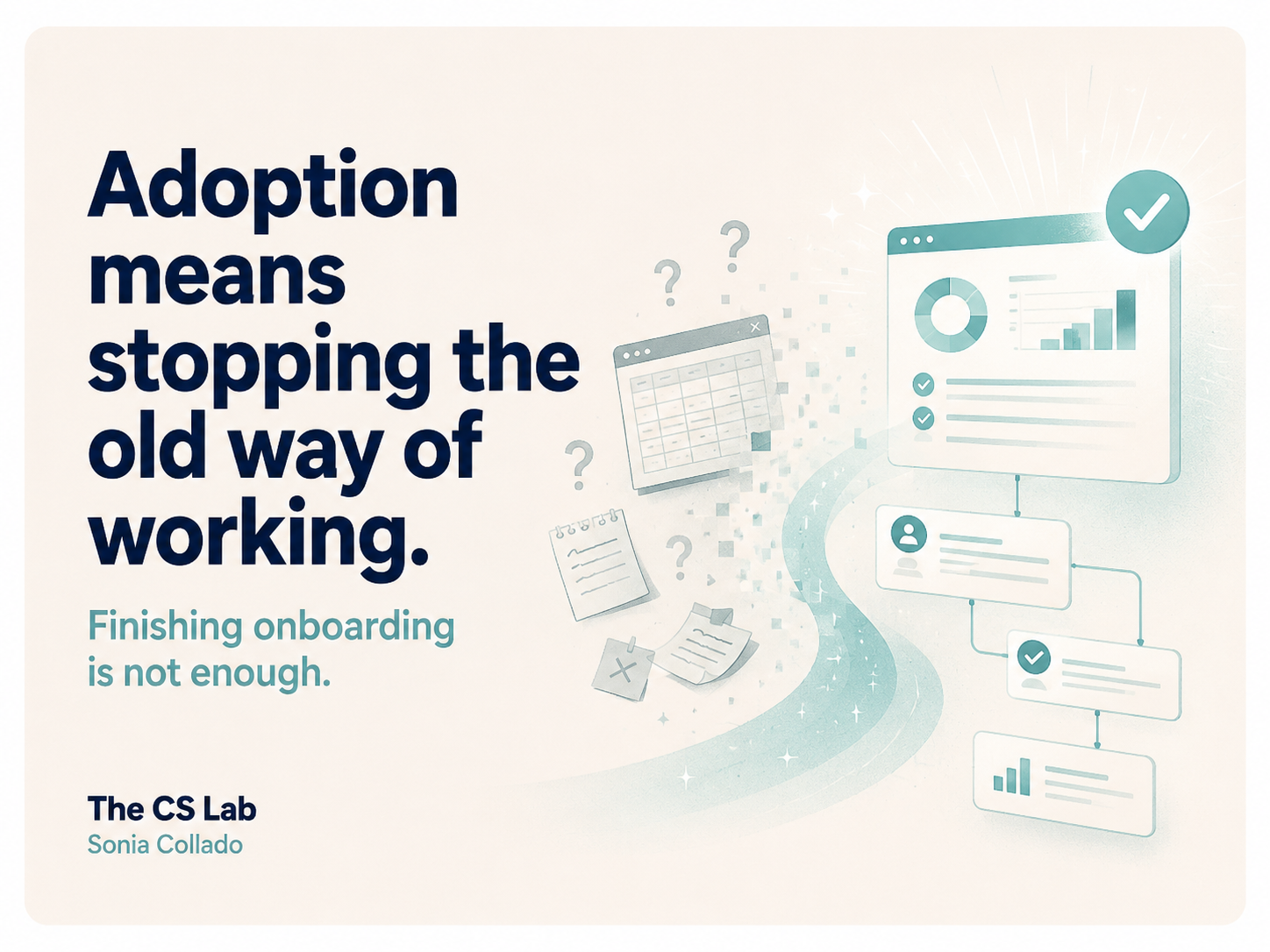
- The client’s old process is still alive after X months. If the client’s team keeps their spreadsheet, their tool or their usual circuit running in parallel to yours, your depth is zero no matter how high usage is. This must be handled by Product or Implementation, because it almost always means there’s a functional gap or a flow that was never fully replaced (in the previous post you have information on how to tackle it).
- The account goes into renewal without having expanded into areas. If you’ve spent a year in the same department with the same scope, you don’t have a consolidated account, you have a stagnant account that looks healthy because it causes no problems. Here who decides is leadership, because entering another area normally requires resources, not just goodwill.
- Concentration exceeds your threshold. When a customer passes a certain weight, it stops being a CS decision. It should be reviewed in committee, with the same naturalness with which the pipeline is reviewed. And whoever brings that point to the committee can’t be the CSM: it has to be someone with the authority to move resources toward that account.
If you look closely at these actions, a clear pattern emerges: there are actions the CSM cannot take.
That’s why, if your only mechanism for large accounts is the CSM being on top of them, you don’t have a plan.
Your portfolio analysis: how to know where you stand
Once a quarter, when a large account comes in, or in a committee review, take your largest account and answer these four questions without opening the CRM:
- How many parts is it really divided into, and how much does each weigh.
- What the customer would have to rebuild if they left tomorrow.
- How many people truly sustain the relationship, not just who’s listed as contacts.
- And how much margin it contributes, not how much invoice.
If you can’t answer any one, there’s where to start., and if you can’t answer any of them, your largest account isn’t tied, it’s just happy or “fine”, which is an even more fragile situation.
Once you have that, the conversation with your team changes, because you’ll stop thinking in terms of “we need to take great care of that account”, which isn’t a plan, and it will become a concrete objective with an owner and a date, for example: enter a second area this quarter, build two more interlocutors before summer, shut down the old process that’s still running in parallel.
That can be tracked in a committee. “Take great care of it” cannot.What you can do today
- If you own the account, don’t wait for the sign of stress. Do the exercise with your two largest accounts and take it to your manager as a diagnosis, not a complaint: here’s the real weight, here are the interlocutors we have, here’s what would fall if this person changed tomorrow. Your job isn’t to shoulder the risk alone, it’s to make it visible before it becomes a lost renewal.
- If you lead the team, stop asking your people to take great care of that account. Give them objectives with an owner and a date, and take to committee what isn’t in their hands: which second area we open, who builds the new interlocutor, what resources are needed. The risk of concentration isn’t delegated downward.
- If you’re the COO or CEO, this isn’t a Customer Success issue. It’s an exposure issue for your business, and today you’re probably measuring it with a health score in green, which tells you how the customer feels, not what it would cost you to lose them. If a person in your largest account changes tomorrow, you want to already know what remains standing without them.
Because you don’t need a funding round or a due diligence for this to matter. It’s enough for your contact at that account to resign on Monday. And that you can’t schedule.
Artículos relacionados